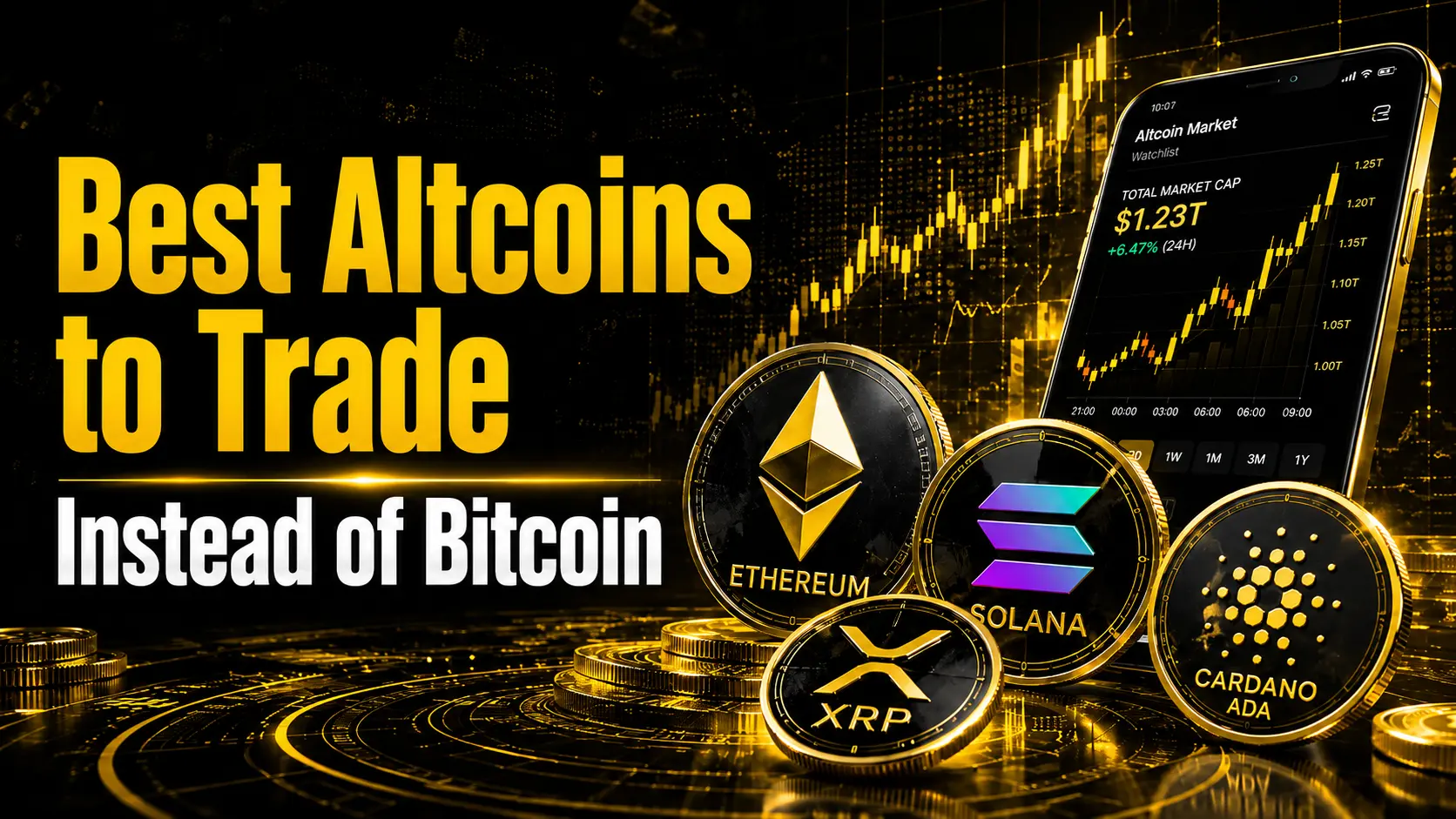
Best Altcoins to Trade Instead of Bitcoin
- Home
- August 27, 2026
Related Posts
Need Professional Trading Help?
The best altcoins to trade instead of Bitcoin are not simply the coins with the biggest price moves. For active traders, liquidity, trading volume, market access, and volatility matter just as much. Bitcoin remains the largest crypto market, but traders have many alternative markets to study. In this guide, we highlight 10 established altcoins that currently show meaningful trading activity and offer different market characteristics. These include Stellar, Sui, NEAR Protocol, Hedera, Arbitrum, Chainlink, Aave, Monero, Filecoin, and Bittensor. Market conditions change quickly, so treat this list as a starting point for research rather than a prediction of future returns.
Why trade altcoins instead of Bitcoin?
Altcoins can give traders access to different market structures, narratives, and volatility than Bitcoin. Some have strong trading volume and broad exchange availability, while others may react more strongly to sector-specific developments.
For active traders, the goal should not be to find a coin that is guaranteed to outperform Bitcoin. Instead, traders can compare different markets and look for setups that match their strategy and risk tolerance.
Before relying on signals, it is also useful to understand what makes a signal service transparent and credible. Our guide to choosing a crypto signal provider covers important factors traders should evaluate.
When comparing a Bitcoin alternative, consider:
- 24-hour trading volume
- Market liquidity and spreads
- Exchange availability
- Volatility
- Market capitalization
- Technical structure
- Trading pair availability
- Overall market conditions
What are the best altcoins to trade instead of Bitcoin?
There is no single best altcoin for every trader. A useful shortlist should combine meaningful liquidity with an active market and a clear trading ecosystem. The following 10 altcoins offer exposure to different crypto sectors and can be researched as alternatives to Bitcoin.
Altcoin | Symbol | Market focus |
Stellar | XLM | Payments |
Sui | SUI | Layer-1 blockchain |
NEAR Protocol | NEAR | Layer-1 ecosystem |
Hedera | HBAR | Enterprise infrastructure |
Arbitrum | ARB | Ethereum Layer-2 |
Chainlink | LINK | Oracle infrastructure |
Aave | AAVE | Decentralized finance |
Monero | XMR | Privacy |
Filecoin | FIL | Decentralized storage |
Bittensor | TAO | Decentralized AI |
1. Stellar (XLM)
The Stellar coin is the native asset of the Stellar network, which focuses on payments and financial applications. XLM has an established market and meaningful trading activity, making it one of the altcoins worth monitoring.
When researching Stellar coin price, traders can examine volume, momentum, support and resistance, and broader market direction rather than focusing on price alone.
2. Sui (SUI)
Sui coin is the native token of the Sui Layer-1 blockchain. Its growing ecosystem and active market make SUI an interesting asset for traders seeking alternatives to larger cryptocurrencies.
When analyzing Sui coin price, traders should consider volatility and liquidity alongside technical indicators. A strong price move without sufficient volume may not provide the same trading conditions as a well-supported move.
3. NEAR Protocol (NEAR)
NEAR Protocol is a Layer-1 blockchain designed to support scalable decentralized applications. The ecosystem has also developed a strong connection with AI-related blockchain initiatives.
For traders following NEAR Protocol coin price, useful factors include trend direction, trading volume, market structure, and important support and resistance levels.
4. Hedera (HBAR)
Hedera coin, commonly known as HBAR, powers the Hedera network. Its focus on enterprise applications and distributed infrastructure gives it a different market profile from Bitcoin.
Traders researching Hedera coin price can monitor volume, momentum, volatility, and key technical levels when assessing potential setups.
5. Arbitrum (ARB)
Arbitrum coin is associated with Arbitrum, an Ethereum Layer-2 ecosystem. The project focuses on improving Ethereum’s scalability and supporting decentralized applications.
When tracking Arbitrum coin price, traders should consider the broader Ethereum and Layer-2 market alongside ARB’s own price structure.
6. Chainlink (LINK)
Chainlink coin, or LINK, powers the Chainlink decentralized oracle ecosystem. Chainlink provides infrastructure that connects blockchain applications with external data and services.
Because LINK has a large and established trading market, Chainlink coin price analysis can be useful for traders looking beyond Bitcoin. Volume confirmation and market structure remain important when evaluating a setup.
7. Aave (AAVE)
Aave is a major decentralized finance protocol focused on lending and borrowing. AAVE is its native governance token.
Traders researching Aave coin price can combine technical analysis with developments across the wider DeFi sector. Changes in market sentiment can influence both AAVE and other DeFi assets.
8. Monero (XMR)
Monero coin is a privacy-focused cryptocurrency designed to provide stronger transaction privacy than many transparent blockchain networks.
XMR can behave differently from other major altcoins. Anyone researching Monero coin price should pay close attention to liquidity, volatility, market structure, and relevant market developments.
9. Filecoin (FIL)
Filecoin is a decentralized storage network, with FIL serving as its native cryptocurrency. Its use case is different from payment-focused assets such as Bitcoin or Stellar.
For traders watching Filecoin price, technical structure, trading volume, and broader sentiment toward decentralized infrastructure can all be useful research factors.
10. Bittensor (TAO)
Bittensor coin, or TAO, is connected to Bittensor’s decentralized machine-intelligence ecosystem. Its AI-related narrative gives it a different market profile from traditional cryptocurrency projects.
Traders following Bittensor coin price should consider volatility and liquidity carefully because narrative-driven markets can experience rapid changes in sentiment.
How should traders choose a Bitcoin alternative?
The right Bitcoin alternative depends on your trading strategy, timeframe, and risk tolerance. Start by checking liquidity, volume, spreads, and available trading pairs. Then examine price structure, volatility, support and resistance, and broader market conditions. Avoid choosing a coin only because its price has recently risen sharply.
If you are comparing signal services to support your research, our guide to the best crypto signals explains what traders should consider when evaluating signal-based trading information.
Are altcoins better than Bitcoin for trading?
Not automatically. Altcoins can provide different trading opportunities, but they can also carry greater volatility and liquidity risks. Some markets react strongly to project news, market narratives, token unlocks, or changes in overall sentiment. Bitcoin may offer deeper liquidity, while certain altcoins can provide different technical setups.
The important question is not whether an altcoin is “better” than Bitcoin. It is whether the current market conditions provide a setup that fits your trading plan.
How can crypto trading signals help with altcoins?
Trading signals can organize a potential trade into elements such as entry, direction, stop-loss, take-profit levels, and timeframe. This can help traders monitor several markets without manually scanning every chart. However, signals are not guarantees and should be treated as one research input rather than a substitute for risk management or independent analysis.
It is also useful to understand how different signal-generation methods work. Our guide comparing AI vs. human crypto signals explores the differences between automated and human-led approaches.
What should you check before trading an altcoin?
Before entering an altcoin trade, review:
- Liquidity: Is there enough market activity for your position size?
- Volume: Is the current move supported by meaningful trading activity?
- Volatility: Does the coin’s movement fit your risk tolerance?
- Market structure: Are important support and resistance levels clear?
- Risk: Where would your trade idea be invalidated?
- News: Are there upcoming events that could affect the market?
You should also be cautious with signal providers making unrealistic claims. Our guide on identifying legitimate crypto signal services covers warning signs traders can look for before subscribing.
Final Takeaway
Bitcoin remains a major cryptocurrency market, but it is not the only market available to active traders. XLM, SUI, NEAR, HBAR, ARB, LINK, AAVE, XMR, FIL, and TAO offer exposure to different sectors and market structures.
The best altcoins to trade can change as liquidity, volume, volatility, and market sentiment change. Instead of chasing the biggest price move, focus on finding markets with suitable liquidity and clearly defined trading setups.
For traders who want help monitoring multiple crypto markets, structured signals can be another research tool. Always review the setup, understand the risks, and use appropriate position sizing before making a trade.
Financial Disclaimer
This article is for educational and informational purposes only. It does not constitute financial, investment, trading, or legal advice. Cryptocurrency trading is highly speculative and can result in substantial losses. Leverage can significantly increase losses as well as potential gains. Past performance does not guarantee future results. Never trade more than you can afford to lose, and conduct your own research before making financial decisions.
Frequently Asked Questions
1. What are the best altcoins to trade instead of Bitcoin?
There is no universal best altcoin. Traders can research assets such as XLM, SUI, NEAR, HBAR, ARB, LINK, AAVE, XMR, FIL, and TAO because they represent established crypto markets with different use cases. The best choice depends on liquidity, volatility, trading timeframe, strategy, and individual risk tolerance.
2. Which Bitcoin alternative has the highest liquidity?
Liquidity changes constantly, so traders should check current market data before entering a position. Larger established altcoins generally have deeper markets than small-cap assets. LINK, SUI, XLM, AAVE, NEAR, and other major altcoins can offer substantial trading activity, but liquidity varies by exchange and trading pair.
3. Is XLM good for trading?
XLM can be an interesting market for traders because Stellar has an established ecosystem and XLM trades across major crypto markets. However, being a well-known altcoin does not automatically make every XLM setup attractive. Traders should evaluate current volume, spreads, volatility, technical structure, and overall market conditions.
4. Is SUI a good alternative to Bitcoin?
SUI can provide traders with exposure to a Layer-1 market rather than Bitcoin. It has an active trading ecosystem and can experience significant price movement. However, higher volatility also creates additional risk. Traders should evaluate the current SUI market, liquidity, technical structure, and their own risk tolerance before trading.
5. Which altcoins are best for active traders?
Active traders typically look for sufficient liquidity, manageable spreads, reliable exchange access, and enough volatility for their strategy. Coins such as XLM, SUI, LINK, AAVE, NEAR, and TAO can be researched for these characteristics. Conditions change quickly, however, so traders should always check current market data rather than relying on an old ranking.
6. Are altcoin trading signals guaranteed to make money?
No. A trading signal is a potential market setup, not a guaranteed result. Prices can move against a trade because of volatility, news, liquidity changes, or unexpected market events. A responsible approach includes defined risk parameters and realistic expectations. Traders should never choose a signal provider solely because it claims unusually high accuracy or guaranteed profits.
7. How do I choose an altcoin trading signal provider?
Look for transparent methodology, clearly defined entries and exits, risk-management information, realistic performance reporting, and clear communication about losses. Be cautious about guaranteed-return claims or selective screenshots showing only successful trades. Traders should also understand whether signals are generated by humans, algorithms, or a combination of both before subscribing.