How Cryptodirectories Filter Scam vs Legit Crypto Signal Services
- Home
- June 29, 2026
Related Posts
Need Professional Trading Help?
The cryptocurrency market is an absolute goldmine for those who know how to trade it. But for every successful trader, there are hundreds of beginners losing their capital.
Many traders turn to crypto signal providers for guidance. They look for experienced analysts to tell them when to buy, when to sell, and where to place their stop-loss.
Unfortunately, the crypto signals industry is notoriously filled with bad actors.
From deceptive pump-and-dump groups to fake “gurus” Photoshopping their profit screenshots, navigating Telegram and Discord signal channels is like walking through a minefield.
This is where cryptodirectories step in.
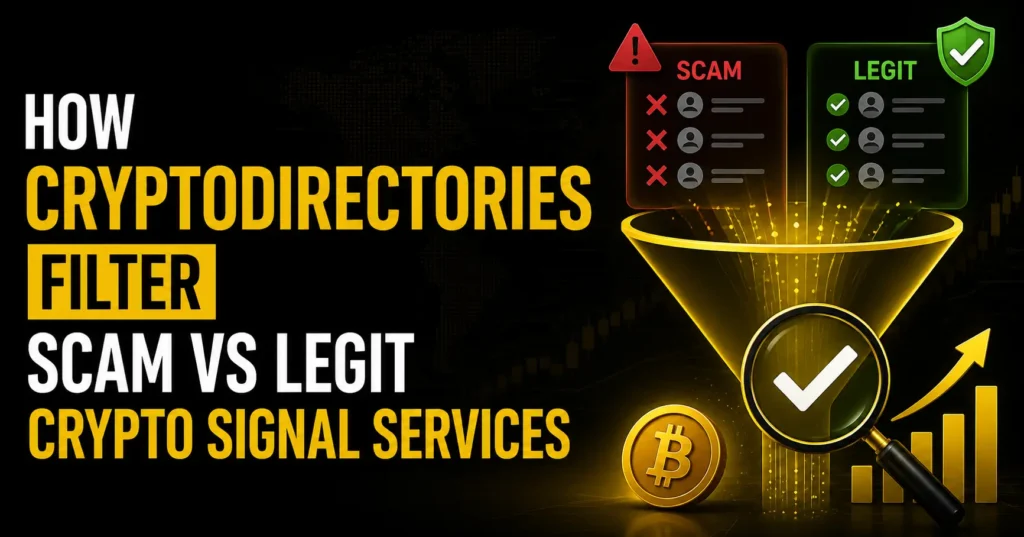
In this comprehensive guide, we are going to pull back the curtain on how cryptodirectories filter scam vs legit crypto signal services. We will explore their rigorous vetting processes, the red flags they look for, and why using a verified signal provider is crucial for your long-term trading success.
The Wild West of Crypto Trading Signals
Let’s be honest about the current state of crypto trading. It moves incredibly fast.
Bitcoin can swing 10% in a single day, and altcoins can double in value within hours. This volatility is highly attractive to both traders and scammers.
Because the industry is largely unregulated, literally anyone can start a Telegram channel, call themselves a “VIP Crypto Trader,” and charge $100 a month for access.
They don’t need a financial license. They don’t need a proven track record. They just need good marketing.
This creates a massive problem for everyday traders. How do you separate the genuine trading experts from the marketing con artists?
If you blindly trust a random Twitter influencer or a flashy YouTube ad, you risk completely liquidating your portfolio. The market requires extreme caution, strict risk management, and reliable data.
What Are Cryptodirectories in the Trading World?
If you want to protect your capital, you need a filter.
Cryptodirectories are centralized platforms, review hubs, and auditing websites dedicated to categorizing and verifying crypto-related services.
Think of them as the Trustpilot or Consumer Reports for the Web3 and cryptocurrency trading space.
Instead of forcing you to randomly guess which Telegram group is legitimate, a crypto directory does the heavy lifting for you. They index signal providers, trading bots, and educational communities.
But their most important function goes far beyond simply listing names.
Top-tier cryptodirectories act as strict gatekeepers. They manually review, audit, and monitor signal providers before allowing them to be ranked on their platforms.
By prioritizing transparency and historical data, these directories force the crypto signals industry to adopt higher standards.
The Anatomy of a Crypto Signal Scam
Before we explain how cryptodirectories filter the bad actors out, you need to understand how these scams operate.
Scam signal providers are incredibly sophisticated when it comes to psychological manipulation. They prey on FOMO (Fear Of Missing Out) and greed.
Here are the most common tactics used by fraudulent crypto signal services.
1. The Photoshopped Binance PnL
Have you ever seen an influencer post a screenshot showing a +800% Return on Equity (ROE)?
While these trades do happen occasionally in high-leverage futures trading, scammers post them every single day.
They use simple web-inspect tools or Photoshop to alter the numbers on a Binance or Bybit PnL card. It creates the illusion that they never lose a trade.
The Pump and Dump Scheme
This is perhaps the most malicious tactic in the crypto space.
A “guru” will quietly buy a massive amount of a micro-cap altcoin. Once their bags are full, they release a “VIP Signal” to their thousands of followers telling them to buy immediately.
As the followers buy in, the price temporarily skyrockets. The guru then dumps their holdings on their own followers, crashing the price and leaving the VIP members with heavy losses.
Deleting Losing Trades
Many fraudulent Telegram channels look highly profitable because they aggressively moderate their chat history.
When they call a trade that hits the stop-loss or gets liquidated, the channel admin simply deletes the message.
To a new subscriber scrolling through the channel’s history, it looks like a 100% win rate. In reality, it is a curated lie.
Botted Engagement Metrics
A Telegram channel with 50,000 subscribers must be legitimate, right? Not necessarily.
Scammers routinely buy fake subscribers, fake views, and fake emoji reactions. They create an illusion of authority and community trust to trick newcomers into paying for VIP access.
How Cryptodirectories Spot Scam Crypto Signal Services
Now that we know the tricks, how do the experts counter them?
Cryptodirectories employ a combination of technological auditing and human investigation to sniff out fraudulent behavior.
They do not take a signal provider’s word at face value. They demand hard, verifiable evidence.
Here is exactly how cryptodirectories filter scam vs legit crypto signal services.
Analyzing Historical Accuracy
A reputable directory will request months of historical trading data before listing a provider.
They cross-reference the signals posted in the VIP channel with the actual market charts from that specific day and time.
If a provider claims they caught a massive Bitcoin long at $60,000, the directory checks the timestamp. If the signal was posted *after* the pump already happened, the provider is instantly flagged and blacklisted.
Searching for "Guaranteed Returns"
In the financial world, there is no such thing as a guaranteed return.
Professional traders understand that losses are an inevitable part of the game. Risk management is about keeping those losses small.
If a cryptodirectory sees a provider using phrases like “Zero Risk,” “Guaranteed 10x,” or “100% Win Rate,” they immediately categorize it as a scam. Legit providers advertise realistic risk-to-reward ratios.
Community Audits and Shadow Bans
Directories often use “mystery shopping” tactics.
The directory auditors will anonymously buy a subscription to a VIP signal group using a burner account.
They sit in the channel for a month, logging every single trade in a private spreadsheet. If they notice the admins deleting losing signals or banning members who ask legitimate questions, the provider fails the audit.
Checking for Copy-Pasted Signals
Some scam providers don’t even analyze the charts themselves.
They secretly subscribe to a highly successful, legitimate VIP group. Whenever the real group posts a signal, the scammer copy-pastes it to their own followers, claiming it as their own.
Directories use text-matching algorithms and timestamp comparisons to ensure the provider is delivering original market analysis.
The Vetting Process: How Legit Crypto Signals Are Verified
Filtering out the scams is only half the battle.
Cryptodirectories must also highlight the true professionals. When a provider passes the initial smell test, they are subjected to a deep-dive verification process.
This process relies heavily on modern API technology and on-chain verification.
Read-Only API Integration
The gold standard for proving trading profitability is via Exchange API.
Legitimate signal providers have no problem connecting their primary trading accounts (Binance, OKX, Kraken) to an auditing platform via a “Read-Only” API key.
This allows the directory to view the trader’s actual live balances, entry prices, and exit prices without having the ability to move the funds.
Because API data pulls directly from the exchange’s backend, it cannot be Photoshopped or manipulated.
Integration with Auto-Trading Bots
Many top-tier signal providers use automated trading bots like **Cornix** or **3Commas**.
When a provider uses Cornix, their signals are sent in a specific, machine-readable format. The bot automatically tracks the performance of every single call.
Cryptodirectories highly favor signal groups that are deeply integrated with these bots because the bot generates an unbiased, mathematically accurate performance report at the end of every month.
Evaluating Risk Management Profiles
A 500% gain means nothing if the trader used 100x leverage and risked their entire portfolio to get it.
Directories evaluate the **Risk-to-Reward (R:R) ratio** of the provider.
They look for analysts who use proper stop-losses (e.g., risking 1-2% of their account per trade). A steady, conservative growth curve is always ranked higher than erratic, high-risk gambling behavior.
Assessing Technical Analysis (TA) Rationale
Legitimate signal providers do not just post “BUY BTC NOW.”
They provide context. They post marked-up TradingView charts. They explain the macroeconomic factors, support and resistance levels, and volume indicators behind their decision.
Expert auditors at cryptodirectories read these updates to ensure the provider actually understands market mechanics and isn’t just flipping a coin.
Why Advanced Traders Rely on Verified Providers
You might be wondering: “If I have to pay for a signal service, why do I care if a directory approves them?”
Even advanced traders utilize cryptodirectories when expanding their strategies.
No single trader can monitor all 10,000+ cryptocurrencies 24/7. An expert Bitcoin trader might want to diversify into Solana meme coins or Ethereum Layer-2 tokens.
Instead of learning a brand new niche from scratch, they seek out a verified specialist.
By using a vetted provider, traders save countless hours of chart-watching. They gain access to institutional-level setups without sacrificing their sleep schedule.
Furthermore, trusting a vetted provider preserves your mental capital. Trading psychology is tough. Knowing your signals come from an audited, proven professional helps reduce the anxiety of a volatile market.
The Future of Crypto Vetting: AI and On-Chain Analysis
The landscape of crypto auditing is evolving rapidly.
As scammers find new ways to deceive traders, cryptodirectories are arming themselves with advanced technological countermeasures. The future of filtering scam vs legit crypto signal services lies in Artificial Intelligence and blockchain transparency.
AI Sentiment and Chat Analysis
In the near future, directories will use AI Signals models to scrape the public chats of signal communities.
AI can detect linguistic patterns associated with scams, such as aggressive up-selling, bots repeating the exact same positive phrases, or admins gaslighting users who complain about losses.
By analyzing the “sentiment” of a Telegram group, directories can flag toxic environments before a human auditor even steps in.
Web3 and Smart Contract Verification
For Decentralized Finance (DeFi) traders, signals often revolve around brand-new token launches on decentralized exchanges like Uniswap.
Directories are beginning to integrate smart contract auditors.
If a signal provider recommends buying a new DeFi coin, the directory’s automated system will instantly scan that coin’s contract for malicious code (like honeypots or 100% sell taxes). If a provider consistently recommends scam tokens, they are immediately blacklisted.
On-Chain Wallet Tracking
Blockchain ledgers are entirely public.
Innovative cryptodirectories are starting to demand the public wallet addresses of the analysts they feature.
By using tools like Nansen or Arkham Intelligence, the directory can track exactly what the analyst is buying and selling in real-time. If the analyst tells their VIP group to “Hold” while secretly selling their own tokens on-chain, the directory will expose them.
Conclusion: Protecting Your Trading Capital
Trading cryptocurrency is hard enough without having to worry about being scammed by your own mentors.
The internet is flooded with fake gurus and malicious actors desperate to drain your wallet. But you do not have to navigate this dangerous landscape alone.
Understanding how cryptodirectories filter scam vs legit crypto signal services is the first step toward securing your financial future.
These platforms serve as your first line of defense. By demanding read-only API access, verifying historical win rates, checking for bot integration, and conducting mystery audits, they ensure that only genuine experts earn your trust.
If you are looking for a reliable signal provider, never blindly buy a subscription based on an Instagram ad. Always check if the provider is listed, audited, and highly rated on reputable cryptodirectories.
At the end of the day, your trading capital is your most valuable asset. Protect it fiercely, rely on verified data, and trade safe.
FAQ
1.What are cryptodirectories?
Cryptodirectories are online platforms that aggregate, review, and audit various cryptocurrency services, including crypto signal providers, trading bots, and exchanges. They act as independent watchdogs to help traders find reliable services and avoid scams.
2.Are paid crypto signals actually worth it?
Yes, but only if they come from a verified, legitimate provider. A reputable signal service can save you hours of technical analysis and provide high-probability trade setups. However, paying for unverified signals is essentially throwing your money away.
3. How do I know if a Telegram crypto signal group is a scam?
Major red flags include guarantees of massive daily profits, deleting losing trade setups, offering “no-risk” investments, and refusing to show API-verified long-term track records. If they rely heavily on high-leverage PnL screenshots without sharing chart analysis, proceed with extreme caution.
4. How do legit providers prove their win rate?
Legitimate providers use transparent tracking systems. They integrate with automated platforms like Cornix, which publicly logs every trade outcome. They may also provide read-only API access to auditors to prove their live exchange balances.
5. Can AI give crypto signals?
Yes, AI can generate crypto signals by analyzing market data, price patterns, sentiment, and trends, helping traders identify potential opportunities faster.